Discussion and Conclusions#
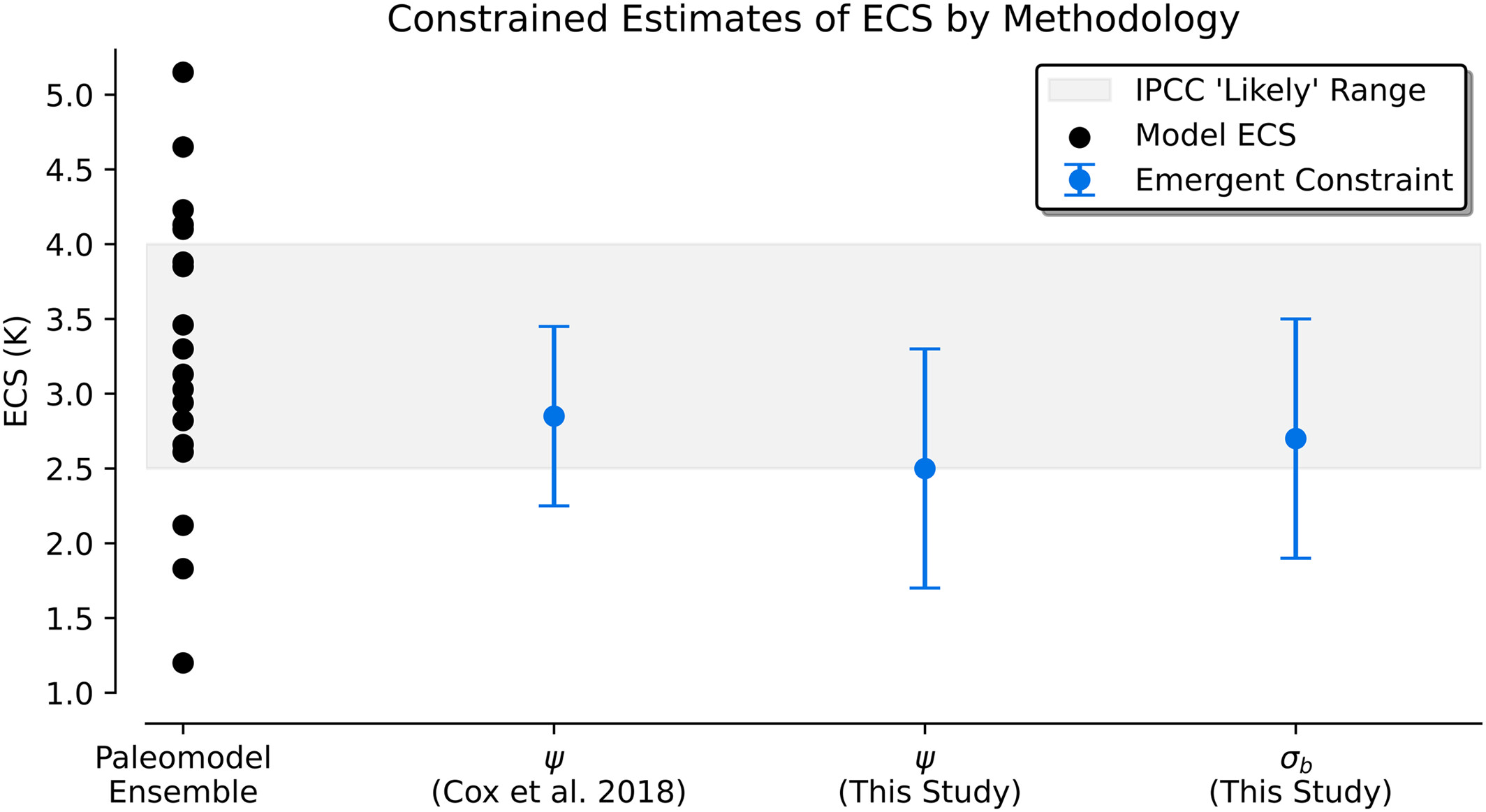
By extending our analysis of the Cox et al. constraint back to the past millennium, we believe we have addressed some (not all) of the concerns related to this important emergent constraint. If the Cox et al. constraint can be confidently believed, then it optimistically suggests that we still have time to perform rapid mitigation of carbon emissions and avoid the worst consequences of climate change. Through our paleoclimate approach, we are able to test the criticisms that the Cox et al. constraint is limited by the a short, instrumental record (from our findings, this appears not to be a limiting factor) and external forcing unique to human-caused climate change in the historical period (we find that the constraint also works under earlier, pre-industrial periods).
While this may sound encouraging, as we mention in our paper there are still many questions that are unfortunately, for now, left unanswered. For example, there is a significant limitation in our study of the small sample size of the model ensemble (n=18). This is due primarily to the lack of simulations of the past1000 experiment (850-1850), which sits in between the popular historical period (1850-2014) and other more focused-on paleoclimate intervals in the deeper past. Therefore, any emergent constraint is subject to new model simulations being released that may dampen enthusiasm for its application. Another issue is that while the PAGES 2k product is validated against historical data, there is no way to easily validate its performance at interannual scales into the paleoclimate Common Era. Therefore, more proxy coverage, and newer statistical methods that more appropriate estimate interannual variability could change the observational estimate, and thus the purported ECS constraint. However, we see our paper as a first step into using the Common Era paleoclimate to address some of these questions, which we can then improve upon in the future.
Acknowledgments#
We acknowledge funding from the National Science Foundation Grant 2002558 through the Paleoclimate Perspectives on Climate Change (P2C2) program (S.C., C.W.T., J.E-G.), and the Regional and Global Model Analysis Program from Climate Model Diagnosis and Intercomparison (C.W.T.). We also thank the World Climate Research Programme’s Working Group on Coupled Modeling and the individual modeling groups for their roles in making CMIP and PMIP data available. We thank Peter Cox, Mark Williamson, and Feng Zhu for their helpful comments and suggestions that improved the present study. Lastly, we thank two reviewers for their constructive feedback on our published work.