Introduction#
Equilibrium climate sensitivity (ECS) is the amount that we would expect for global mean surface temperature (GMST) to rise if we were to double atmospheric concentrations of carbon dioxide. At a basic level, ECS could be thought of as how sensitive our Earth’s global temperatures are to increased greenhouse gas forcing. While there certainly have been numerous past efforts to quantify ECS, it has unfortunately remained highly uncertain due to variations in how models represent the various climate feedbacks.
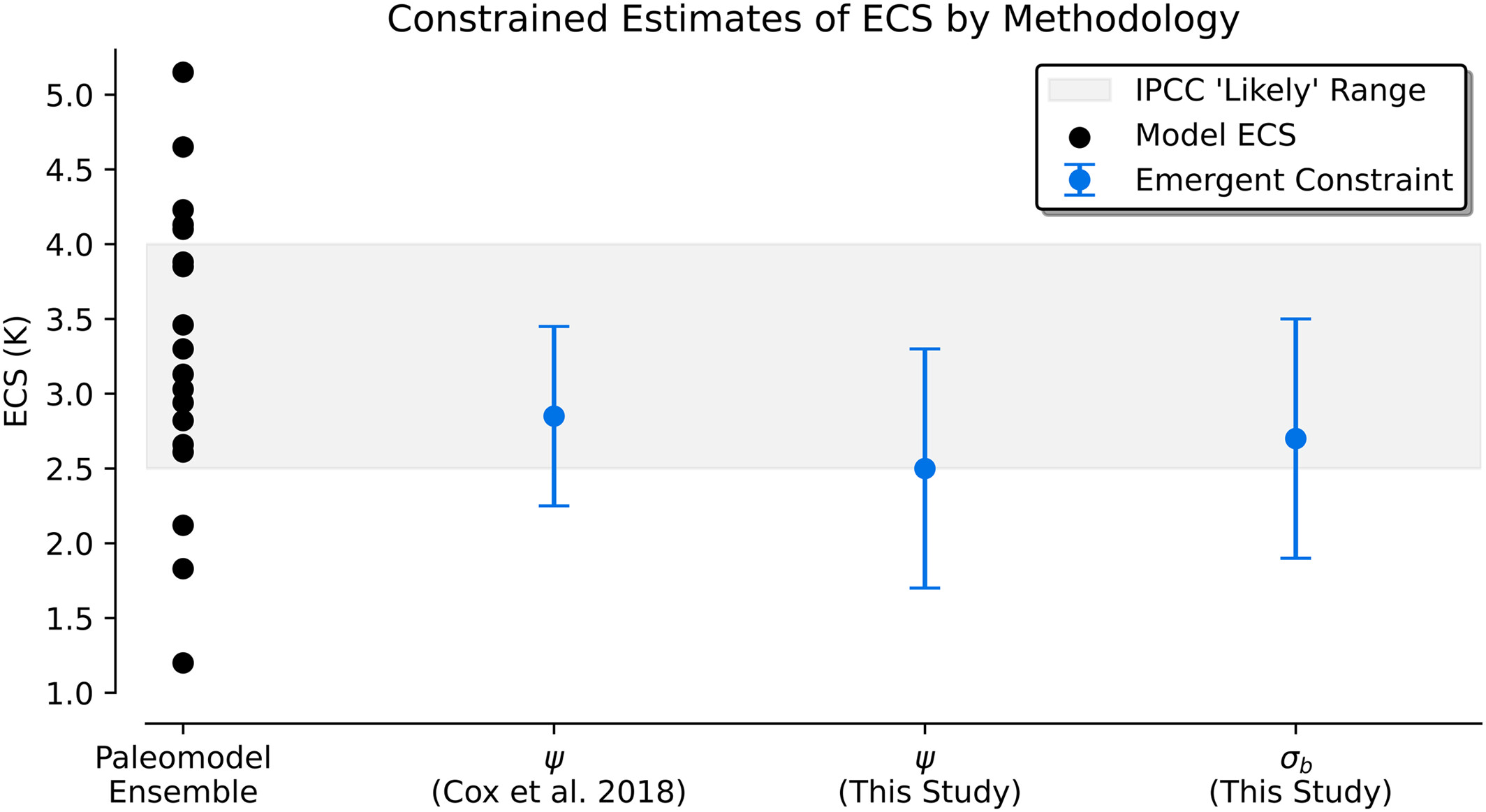
Recently, the IPCC reported that the ECS likely range as estimated by the scientific community has been reduced to between 2.5 and 4.0 K. But still, this range is extremely high and an ECS of 4.0 K would impy a drastically more extreme outcome from climate change than a lower estimate.
One technique which has been little utilized in this space, but holds great promise, is known as “emergent constraints.” An emergent constraint looks for correlations between an observable climate feature, like global temperature variability, and a metric of future change, like ECS, that is often hard to predict or otherwise impossible to directly measure.
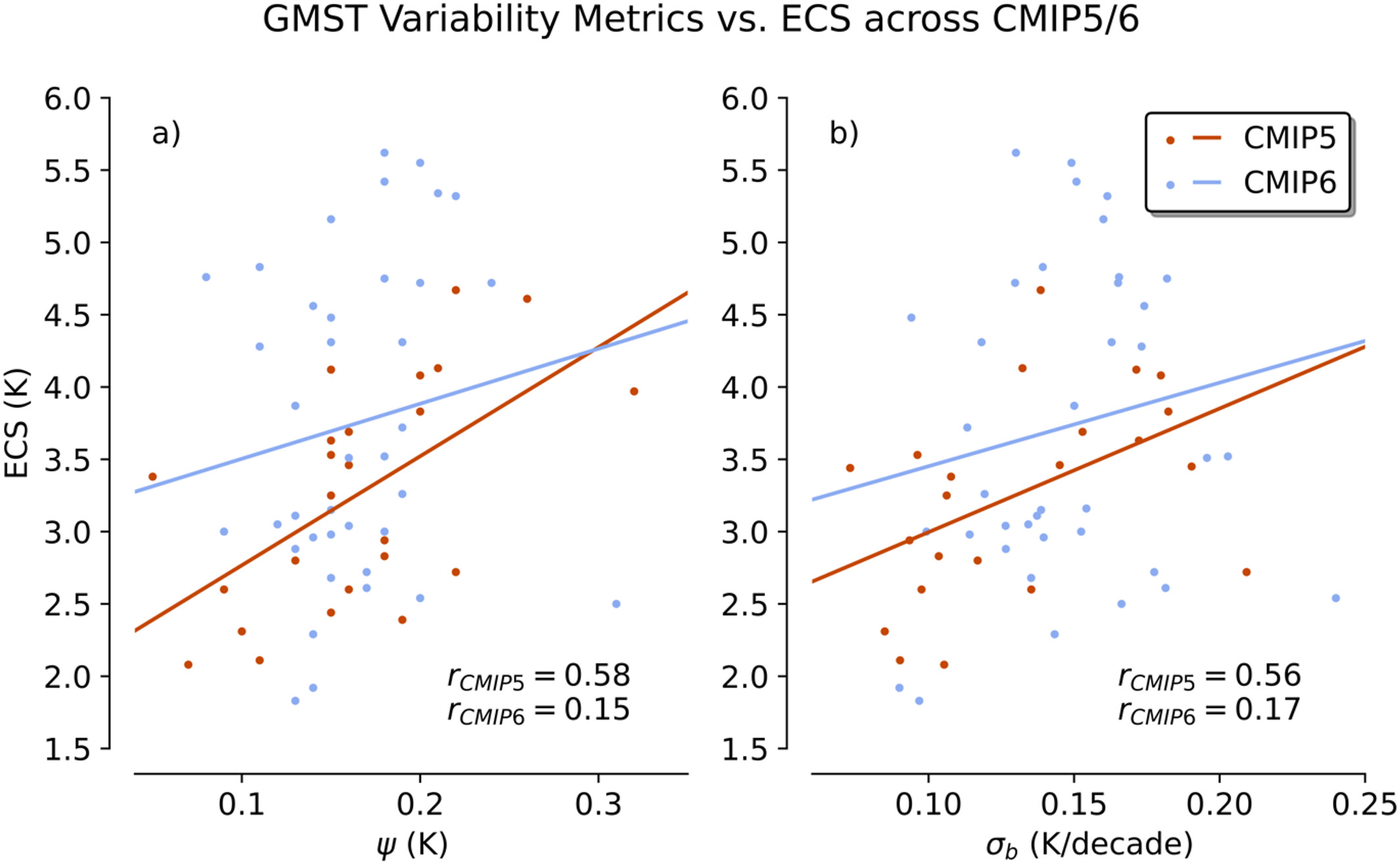
In this paper, we revisit an emergent relationship proposed by Cox et al. (2018), which suggested that short-term variability in historical GMST might be linked to ECS across an ensemble of CMIP5 climate models. This previous analysis, however, broke down under a different climate model ensemble (CMIP6) and only relied on the past century or so of climate data (approximately 100 years). You can see that in Figure 1 of the manuscript (below). It shows that while CMIP5 data exhibit significant correlation, it’s much weaker for CMIP6:
To build upon the Cox et al. analysis, we extend the investigation to the recent paleoclimate of the Common Era (850-1850) in addition to a historical period (1980-1999). We do this by analyzing an ensemble of paleoclimate model simulations from the Paleoclimate Model Intercomparison Project (PMIP) versions 3 and 4. By analyzing this paleoclimate scenario, hope to test whether the original claims of the Cox et al. investigation can hold under a longer record and a somewhat independent model ensemble.